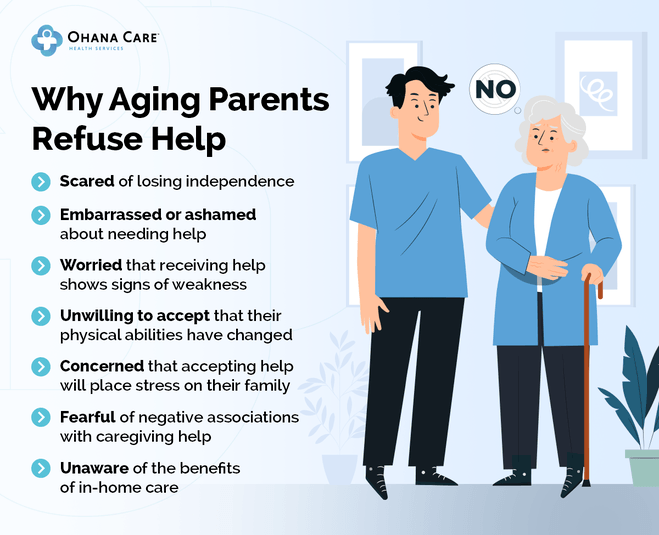
When Parents Refuse Care, This Is What They’re Really Afraid Of
When an aging parent says “I don’t need help”, it rarely means what it sounds like.
Behind that refusal is often fear—deep, unspoken, and very human.
Understanding those fears can change everything about how the conversation goes.
1. “If I accept help, I’m admitting I’m no longer myself.”
For many older adults, independence isn’t just practical—it’s identity.
They’ve spent decades:
Raising children
Working hard
Making decisions for others
Needing help can feel like losing their role, their dignity, and their sense of worth.
💭 “If I let someone help me shower… who am I now?”
2. Fear of Losing Control
Care often feels like a slippery slope:
“First help… then rules… then strangers… then no say at all.”
Parents worry that once care starts:
Decisions will be made for them
Routines will change without consent
Their home will stop feeling like their home
Refusal is sometimes the only control they feel they still have.
3. Fear of Being a Burden
Many parents carry silent guilt.
They think:
“My child already has enough stress.”
“I don’t want to cost them money.”
“They shouldn’t have to take care of me.”
So they say no—not because they don’t need help, but because they love you.
4. Fear of Judgment and Shame
Accepting care can feel like being exposed.
They worry:
Someone will notice their memory lapses
Their home isn’t “good enough”
Their body isn’t what it used to be
Shame keeps people silent. Silence looks like refusal.
5. Fear of What Comes Next
Care is often associated with decline, illness, or “the end.”
To them, accepting care can feel like:
Giving up
Saying goodbye to the future they imagined
Facing mortality before they’re ready
So they push it away.
What Doesn’t Help (Even Though It Feels Logical)
❌ Arguing with facts
❌ Saying “It’s for your own good”
❌ Threatening outcomes
❌ Comparing them to other seniors
Fear doesn’t respond to logic.
It responds to safety, respect, and choice.
What Does Help
Try language like:
“I want to support you, not take over.”
“You’re still in charge—I’m just here to help.”
“Let’s start small. We can change it anytime.”
“This is about making life easier, not taking anything away.”
Start with their goals, not your worries.
A Gentle Truth for Adult Children
If you’re feeling frustrated, exhausted, or rejected—
it doesn’t mean you’re doing something wrong.
It means you’re walking into one of the hardest emotional transitions a family faces.
💛 Refusal is not rejection.
💛 It’s fear asking to be understood.